
Best Generative AI Training in Mohali, Chandigarh & Gurdaspur: Master LLMs & Next-Gen AI Engineering at Future Finders
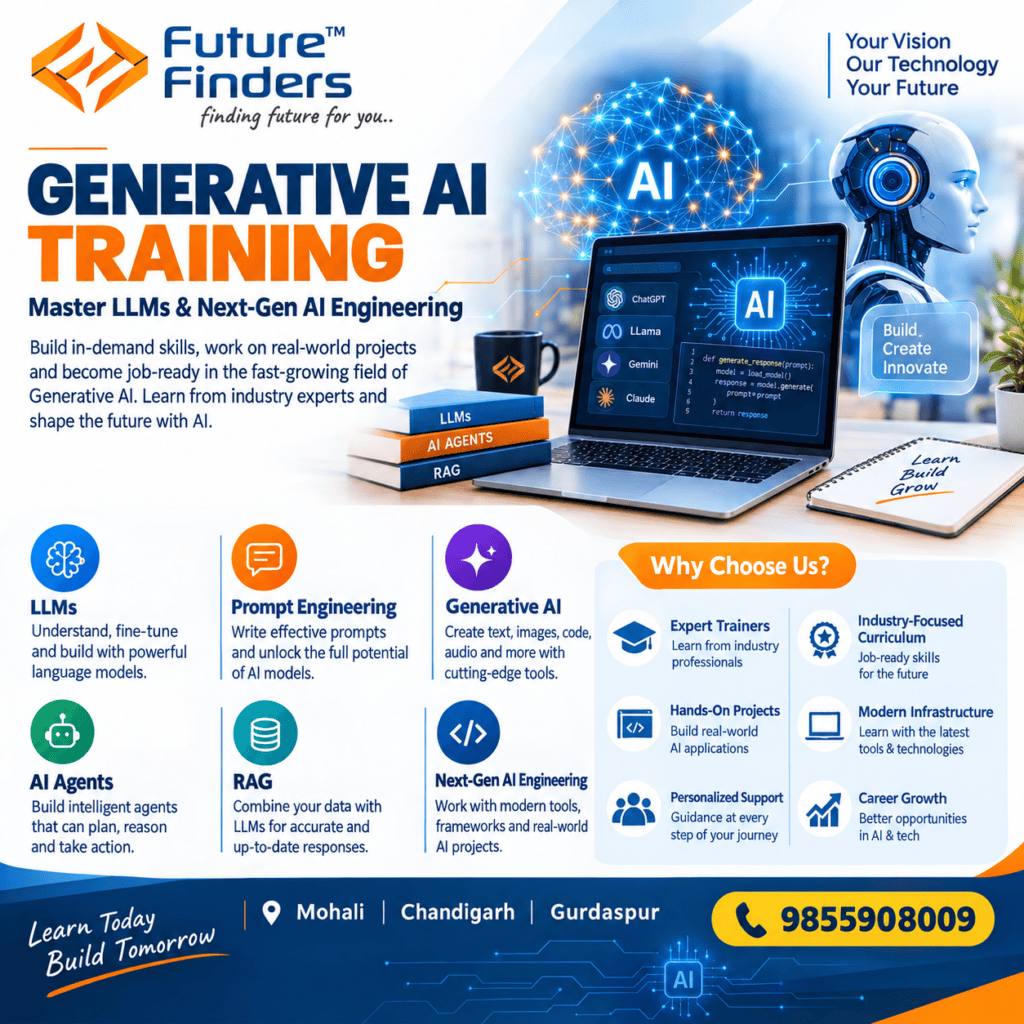
Step into the forefront of modern artificial intelligence with the best Generative AI training in Mohali, tailored to turn software engineers, data analysts, students, and tech professionals into production-ready GenAI and Large Language Model (LLM) application developers. Future Finders provides a practical, industry-aligned training curriculum focused on transformer architectures, retrieval-augmented generation (RAG), autonomous AI agents, and enterprise model integration. Whether you are searching for the best Generative AI training in Chandigarh or seeking the best Generative AI training in Gurdaspur, our hands-on classroom cohorts and instructor-led online sessions prepare you to build real-world AI applications and lead technical innovation.
Through dedicated lab projects, you will transition from core deep learning and natural language processing (NLP) fundamentals to cutting-edge generative frameworks. Work directly with OpenAI APIs, open-source models (Llama, Mistral), vector databases, LangChain, LlamaIndex, and model fine-tuning techniques (LoRA/QLoRA). Learn how to eliminate hallucinations, architect enterprise search engines, deploy multi-agent workflows, and containerize AI models for production environments. With dedicated career mentoring, portfolio optimization, and placement assistance across Mohali, Chandigarh, and Gurdaspur, Future Finders ensures you secure high-paying roles as a GenAI engineer, AI solutions architect, or machine learning specialist.
What is Generative AI?
Generative Artificial Intelligence refers to computational models capable of creating new, original content—such as coherent text, complex code, photorealistic images, and synthetic audio—by learning patterns from massive unstructured datasets. Modern GenAI development centers around powerful enterprise building blocks:
- Transformer Architectures & LLMs: Utilizing multi-head self-attention mechanisms that understand deep context, semantics, and intent across vast sequences of data.
- Retrieval-Augmented Generation (RAG): Connecting proprietary enterprise documents and external knowledge bases directly to language models to generate accurate, source-grounded answers without hallucination.
- Autonomous AI Agents & Tool Calling: Empowering models to reason, plan multi-step workflows, execute code, call external APIs, and browse databases independently.
Core Advantages of a Career in Generative AI
Generative AI is reshaping every sector of technology, finance, healthcare, and enterprise software. Organizations are actively hiring engineers who can bridge the gap between foundation models and practical business systems. Mastering prompt optimization, context embeddings, semantic search, and model adaptation gives developers a significant competitive edge, commanding top-tier salaries and opening diverse roles across AI product engineering, ML research, and intelligent automation.
Learn from Proven AI Practitioners & Data Architects
Future Finders provides the best Generative AI course in Mohali and the northern tech region through veteran machine learning engineers and enterprise AI architects. Our mentors bring hands-on experience deploying commercial AI products and automated pipelines with tier-1 technology firms and global consultancies. Having architected secure private LLM solutions, proprietary search engines, and intelligent customer agents, our instructors ensure that students across Mohali, Chandigarh, and Gurdaspur learn real production deployment strategies, GPU optimization, and ethical safety guardrails rather than basic prompt-copying tutorials.
Specialized Allied Technology Modules
Modern AI engineers need a comprehensive software and infrastructure foundation. Our Generative AI training in Mohali, Chandigarh, and Gurdaspur integrates critical supporting modules into your learning path:
- Python for Deep Learning & Math Foundations: Solidify core Python proficiency, linear algebra, probability, vector spaces, and foundational libraries including NumPy, Pandas, and PyTorch.
- Vector Databases & Semantic Search: Gain practical command over leading vector stores including Pinecone, ChromaDB, Weaviate, and Milvus for high-dimensional similarity search.
- DevOps for AI (LLMOps) & Deployment: Learn to manage the lifecycle of foundation models using Docker, model monitoring platforms (LangSmith, Weights & Biases), and cloud GPU deployment (Hugging Face Spaces, AWS Bedrock).
- API Integration & Cloud AI Platforms: Integrate cloud-native generative solutions across Azure OpenAI Service, AWS Bedrock, Google Vertex AI, and Hugging Face pipelines.
- AI Safety, Guardrails & Evaluation: Implement validation layers using NeMo Guardrails, guardrail libraries, toxicity filters, and automated evaluation frameworks (Ragas, TruLens) to prevent jailbreaks and data leakage.
Core Technical Pillars & Architecture
Our program delivers production-ready engineering skills with practical coding depth across foundational, framework-driven, and model adaptation pillars:
- Foundations of NLP & Transformers: Understand tokenization, word embeddings (Word2Vec), positional encodings, encoder-decoder networks, and self-attention mechanics.
- Prompt Engineering & Context Optimization: Master zero-shot, few-shot, Chain-of-Thought (CoT), Directional Stimulus, and ReAct prompting techniques to optimize model performance and lower token costs.
- Building with LangChain & LlamaIndex: Implement production pipelines with chains, memory states, structured output parsers, callback handlers, and data indexers.
- Advanced Retrieval-Augmented Generation (RAG): Design multi-tier RAG architectures, document chunking strategies, contextual embeddings, hybrid search (keyword + semantic), and reranking models.
- Autonomous AI Agents & Function Calling: Build multi-agent collaborative systems using LangGraph, CrewAI, or AutoGen, equipping models with calculators, SQL query generators, and external web-scraping tools.
- Open-Source Models & Local Deployment: Run, quantize (GGUF, AWQ), and serve open-source foundation models (Llama, Mistral, Gemma) locally using Ollama, vLLM, and Hugging Face Transformers.
- Fine-Tuning LLMs (PEFT & LoRA): Understand full fine-tuning vs. parameter-efficient fine-tuning (PEFT), preparing domain-specific instruction datasets, applying LoRA/QLoRA, and tracking training runs.
- Multi-Modal AI & Diffusion Models: Work with multi-modal LLMs (GPT-4o, Gemini Vision) to analyze images, charts, and video feeds, along with an architectural overview of image generation models (Stable Diffusion).
Advanced AI Engineering: Practical Industry Focus
Whether you enroll for the best Generative AI training in Mohali, join interactive classes through the best Generative AI training in Chandigarh, or sign up for dedicated cohorts for the best Generative AI training in Gurdaspur, Future Finders ensures you develop real engineering competence:
- Real-World Capstone Projects: Build complete end-to-end applications, such as internal enterprise document search systems, autonomous SQL agents, and multi-modal customer support copilots.
- Private & Secure Architecture First: Learn to deploy air-gapped, privacy-compliant LLM architectures that safeguard corporate intellectual property and adhere to enterprise data security standards.
- Modern Toolchain Mastery: Work directly with cutting-edge tools including LangChain, LangGraph, Ollama, Hugging Face, and Vector DBs.
- Dedicated Career Support: Benefit from technical mock interviews, portfolio code reviews on GitHub, system design discussions for AI systems, and direct placement drives with top IT recruiters.
Generative AI Course
- Day 1: Setup Python, VS Code, Jupyter, Colab, Git
- Day 2: Python practice: variables, loops, functions
- Day 3: Python practice: lists, dicts, file handling
- Day 4: Call APIs with requests, parse JSON
- Day 5: ChatGPT/Gemini/Claude playground hands-on
- Day 6: Prompt writing lab: role, context, format
- Day 7: Prompt lab: few-shot, chain-of-thought tasks
- Day 8: OpenAI/Gemini API: first chat script
- Day 9: API: system prompts, temperature, tokens
- Day 10: Build CLI chatbot with memory
- Day 11: Structured JSON outputs from LLMs
- Day 12: Text tasks: summarizer, translator, rewriter
- Day 13: Build email/resume generator script
- Day 14: Mini project: AI content generator
- Day 15: Streamlit basics: UI widgets
- Day 16: Deploy chatbot UI with Streamlit
- Day 17: Hugging Face: load and run models
- Day 18: Text classification and sentiment with HF
- Day 19: Text generation and fill-mask pipelines
- Day 20: Image generation with Stable Diffusion
- Day 21: Image captioning and image Q&A
- Day 22: Speech-to-text with Whisper
- Day 23: Text-to-speech and voice assistant
- Day 24: Mini project: multimodal assistant
- Day 25: Embeddings: generate and compare vectors
- Day 26: Vector DB setup (Chroma/FAISS)
- Day 27: Document loading and chunking (PDF, DOCX)
- Day 28: Build semantic search engine
- Day 29: RAG pipeline with LangChain
- Day 30: Chat with your PDF app
- Day 31: RAG improvements: retrievers, reranking
- Day 32: LangChain chains, prompts, output parsers
- Day 33: LangChain memory and conversation bots
- Day 34: Agents and tools (calculator, search)
- Day 35: Build web-search AI agent
- Day 36: Function calling lab
- Day 37: Fine-tuning basics with LoRA on Colab
- Day 38: Evaluate and compare model outputs
- Day 39: Guardrails, moderation, error handling
- Day 40: FastAPI: wrap AI app as REST API
- Day 41: Deploy on Hugging Face Spaces/Render
- Day 42: Capstone: planning and setup
- Day 43: Capstone: build core features
- Day 44: Capstone: UI, testing, deployment
Day 45: Capstone demo, GitHub README, portfolio
- Week 1: Python lab, Git, API calls, JSON
- Week 2: Prompt engineering lab with real tasks
- Week 3: LLM APIs: chat, tokens, structured output
- Week 4: Mini project: AI content/chat tool
- Week 5: Streamlit UI and deployment
- Week 6: Hugging Face: text, image, audio models
- Week 7: Embeddings and vector databases
- Week 8: RAG: chat with PDFs/websites
- Week 9: LangChain chains, memory, agents
- Week 10: Function calling and tool-using agents
- Week 11: LoRA fine-tuning and evaluation
Week 12: Capstone project, FastAPI deploy, demo
- Week 1: Python setup, scripting practice
- Week 2: Python data handling, files, APIs
- Week 3: Git/GitHub, virtual envs, project structure
- Week 4: Prompt engineering lab
- Week 5: LLM API chatbots
- Week 6: Structured outputs, JSON schema tasks
- Week 7: Mini project 1: AI writer
- Week 8: Streamlit/Gradio apps
- Week 9: Hugging Face text models
- Week 10: Hugging Face image models
- Week 11: Speech: Whisper, TTS
- Week 12: Mini project 2: multimodal assistant
- Week 13: Embeddings lab
- Week 14: FAISS/Chroma/Pinecone
- Week 15: RAG basics: PDF chatbot
- Week 16: Advanced RAG: hybrid search, reranking
- Week 17: LangChain deep lab
- Week 18: LlamaIndex lab
- Week 19: AI agents with tools
- Week 20: Multi-agent workflows (CrewAI/LangGraph)
- Week 21: LoRA/QLoRA fine-tuning
- Week 22: Evaluation, guardrails, logging
- Week 23: FastAPI, Docker, cloud deployment
Week 24: Capstone build, demo, portfolio